
Table of Contents
In the vast landscape of anime and manga, the concept of a “villain” is almost traditionally intertwined with immense destructive power, catastrophic magical abilities, or the ambition to conquer galaxies. We are accustomed to antagonists who measure their worth through visual spectacle, world-ending threats, and grand ideological declarations.
However, in 1994, legendary mangaka Naoki Urasawa shattered this paradigm entirely with his psychological masterpiece, Monster. Urasawa introduced a young, blond man with calm, flawless features, an elegant coat, and a warm, low voice that could soothe a child. He possessed no supernatural powers, carried no magical artifacts, and engaged in no physical combat. Yet, with a single whisper or a fleeting smile, he could plunge an entire city into chaos and drive groups of people to collective madness.
This is Johan Liebert. He is not merely an antagonist in a thriller; he is a profound study in pure psychological horror. Decades after his introduction, Johan remains undisputed at the peak of anime’s greatest villains. Here is an in-depth analysis of why his chilling legacy endures.
1. The Angelic Facade: Evil Cloaked in Purity

The first and perhaps most striking aspect of Johan Liebert is his profound, serene beauty. In conventional media, villains are visually distinct—marked by sharp features, scars, menacing eyes, or manic, theatrical laughter. Johan subverts this trope completely. He possesses an angelic, almost divine appearance that naturally inspires trust, innocence, and warmth.
This stark visual contradiction between his gentle exterior and his inner void creates a profound sense of cognitive dissonance. Johan is not a monster lurking in the shadows; he is a monster walking in broad daylight. He smiles at children, speaks with exquisite politeness to the elderly, and easily earns the absolute trust of everyone he encounters.
His charisma is not rooted in fear or physical intimidation, but in an irresistible, magnetic pull. Victims are drawn to him willingly, completely unaware that they are walking into an abyss. This absolute calm is what makes him terrifying. Human beings inherently fear the unpredictable, and Johan’s unwavering composure acts as a still, placid lake that hides countless bodies beneath its surface.
2. Psychological Manipulation as a Weapon

If a warrior’s power lies in their blade, Johan’s power lies entirely in his deep, terrifying understanding of the human psyche. Johan Liebert is the ultimate psychological manipulator. He does not need to hold a gun to his victims’ heads; he simply converses with them.
Johan possesses an uncanny, near-supernatural ability to read people. Within minutes, he can detect a person’s deepest psychological fractures, hidden guilt, repressed desires, or buried trauma. Once he identifies these internal vulnerabilities, he gently presses upon them, using precisely tailored words to slowly dismantle their sanity until the victim genuinely believes that murder or suicide is the only logical conclusion.
The most horrific demonstration of this ability occurred during his childhood at 511 Kinderheim, a notorious East German orphanage designed to brainwash children into emotionless soldiers. Johan did not lead an armed rebellion; he merely whispered into the ears of his peers and instructors, amplifying their deep-seated doubts, paranoias, and hidden resentments. The result was a massive, self-inflicted massacre where the entire facility tore itself apart, while a young Johan sat peacefully in the center of the room, watching the carnage with his signature, tranquil smile.
3. The Philosophy of Absolute Nihilism
What do traditional villains want? Wealth, political power, immortality, or revenge against a society that wronged them. These motives are grounded, material, and ultimately comprehensible. Johan, however, defies conventional motivation because his driving force is purely philosophical and absolute: he is the living embodiment of Absolute Nihilism.
Johan firmly believes that human life is completely devoid of intrinsic value, meaning, or purpose. To him, the only true equalizer among human beings—regardless of their intelligence, wealth, race, or status—is Death.
In Johan’s eyes, the world is nothing but a grand, absurd theater, and he views himself as the only one brave enough to look directly into the abyss and accept this reality. Consequently, his crimes are never driven by sadistic pleasure or emotional malice; they are philosophical experiments designed to prove his worldview. When he drives someone to ruin, it is not out of hatred, but to demonstrate that their clinging to life was a mere illusion, and that returning to non-existence is the ultimate truth.
This lack of recognizable human desires makes him impossible to bargain with, impossible to threaten, and completely immune to emotional appeal. You cannot take anything from a man who desires nothing, and you cannot terrify a man who views his own demise as a natural conclusion.
4. Tenma vs. Johan: An Ideological Battleground

It is impossible to truly understand Johan Liebert without analyzing his symbiotic relationship with Dr. Kenzo Tenma, the brilliant, deeply empathetic neurosurgeon who saved Johan’s life when he was a child with a bullet wound to the head. This single act of pure, selfless humanity is what set the entire narrative into motion.
The dynamic between Tenma and Johan is not a standard cat-and-mouse chase between a detective and a criminal; it is an intense philosophical debate over the value of human existence:
- Dr. Tenma represents the highest moral ideal: the belief that all human lives are equal in value, and that every individual deserves the right to be saved.
- Johan Liebert represents the absolute inversion: the belief that all human lives are equal in their lack of value, and that death is the only shared reality.
Johan views Tenma as a parental or even creator-like figure because Tenma brought him back from the brink of death. Because of this, Johan’s ultimate goal is not to kill Tenma, but to shatter Tenma’s moral foundation. He orchestrates events to force this pure, compassionate doctor—who swore an oath to protect life—to pick up a gun and become a murderer. Johan wants to prove to Tenma that his greatest act of kindness was his greatest mistake, and that absolute evil can corrupt even the purest soul.
5. The Tragic Genesis: How a Monster is Made
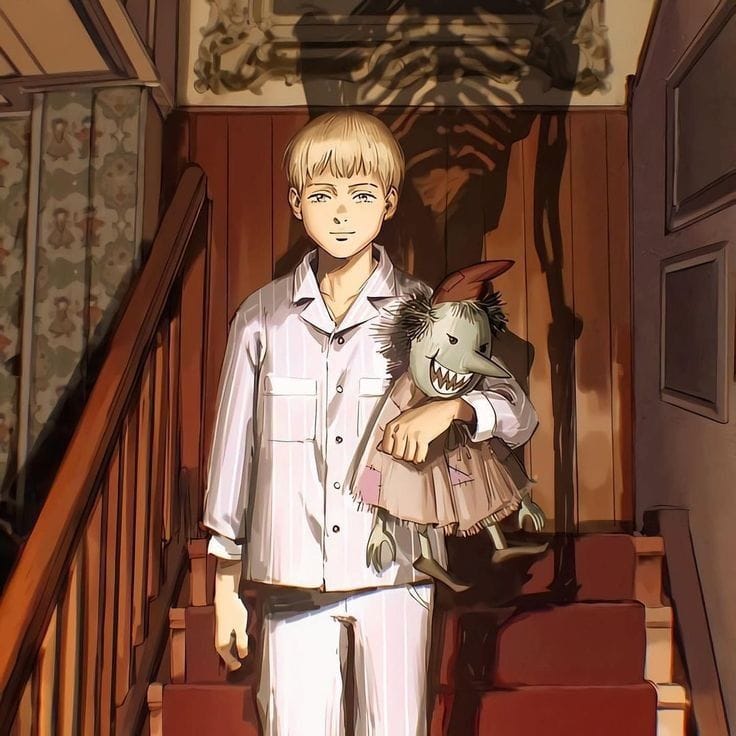
While Johan often feels like a phantom or an abstract force of nature, Urasawa masterfully unravels his tragic origins. Johan is not evil by birth; he is the product of a terrifying, systemic environment born from the cold political experiments of post-WWII Eastern Europe.
From eugenics and psychological conditioning inflicted upon his mother, to the twisted psychological fairy tales read to him in the Mansion of Red Roses, to the brutal environment of 511 Kinderheim, Johan and his twin sister, Anna, were methodically stripped of their humanity, names, and identities from infancy.
The true horror of Johan’s past lies in his profound identity crisis. He was treated as an experiment, a number, or a blank slate meant to become the “ideal leader” for a new world order. This systematic destruction of his childhood left an Echoing, black void within him. Johan never experienced love, safety, or stability; he only knew the terror of erasure and the fear of losing his own name.
Thus, his adult atrocities are a distorted, magnified reflection of the horrors inflicted upon him as a child. He is a monster crafted by human hands, unleashed upon the world to hold a mirror up to the society that created him.
6. The Scenery of the Doomsday
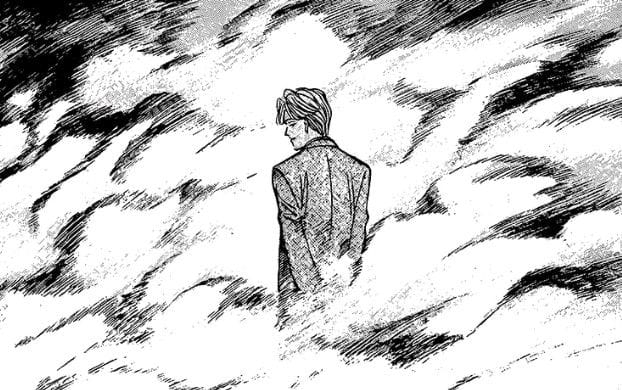
While most ambitious villains seek to build empires that echo through history, Johan’s ultimate objective is a concept he refers to as “The Scenery of the Doomsday”. He does not wish to rule; he seeks to commit the “perfect suicide.”
In Johan’s philosophy, the perfect suicide does not merely mean ending his own physical life; it means erasing every single trace of his existence from the universe. He meticulously plans to eliminate everyone who ever knew him, everyone who ever spoke his name, and every record or piece of paper that could prove he ever walked the earth. He wants to disappear into absolute nothingness, leaving behind a blank void, as if he were nothing more than a collective, passing nightmare.
This pursuit of total annihilation—turning the world into a desolate landscape devoid of human memory—is the zenith of nihilistic thought. A villain who does not even wish for his name to be remembered transcends standard narcissism, ascending into a realm of pure, unadulterated darkness.
Conclusion: The Unfading Shadow of the Monster
The genius of Johan Liebert lies in the fact that he mirrors our most realistic, tangible fears. In our daily lives, we do not fear alien invasions or supernatural curses; we fear the brilliant, charming, and highly manipulative individual who can worm their way into our trust, exploit our weaknesses, and dismantle our lives with nothing more than words. Johan represents human evil in its most plausible, terrifying form.
Naoki Urasawa did not write an antagonist meant to be defeated in a clash of physical strength; he created a dark reflection of human nature itself. When watching Johan slowly unravel the lives of those around him, the audience isn’t left wondering, “How will the hero overpower him?” Instead, we are forced to ask ourselves a far more unsettling question: “If I were trapped in a room with him, would my morals hold true, or would he find the monster hiding within me?”
It is this profound, uncomfortable psychological depth that cements Johan Liebert’s legacy. He remains the gold standard of storytelling—a villain who proved that a quiet, whispered word can be infinitely more destructive than the loudest explosion.