Table of Contents
In the vast world of animation, finding a great short anime can be a challenge as popular long-running titles often overshadow smaller projects. While mainstream hits dominate the conversation, there is a hidden treasure trove of “Hidden Gem” series—high-quality short anime that deliver a powerful punch in 13 episodes or fewer. If you are tired of the same repetitive recommendations and want to discover a unique and engaging short anime, this list is for you. These masterpieces prove that you don’t need hundreds of episodes to tell a legendary story.
The Philosophy of Short Anime: Why 13 is the Magic Number
In the vast world of animation, finding a great short anime can be a challenge as popular long-running titles often overshadow smaller projects. While mainstream hits dominate the conversation, there is a hidden treasure trove of “Hidden Gem” series—high-quality short anime that deliver a powerful punch in 13 episodes or fewer. If you are tired of the same repetitive recommendations and want to discover a unique and engaging short anime, this list is for you. These masterpieces prove that you don’t need hundreds of episodes to tell a legendary story.
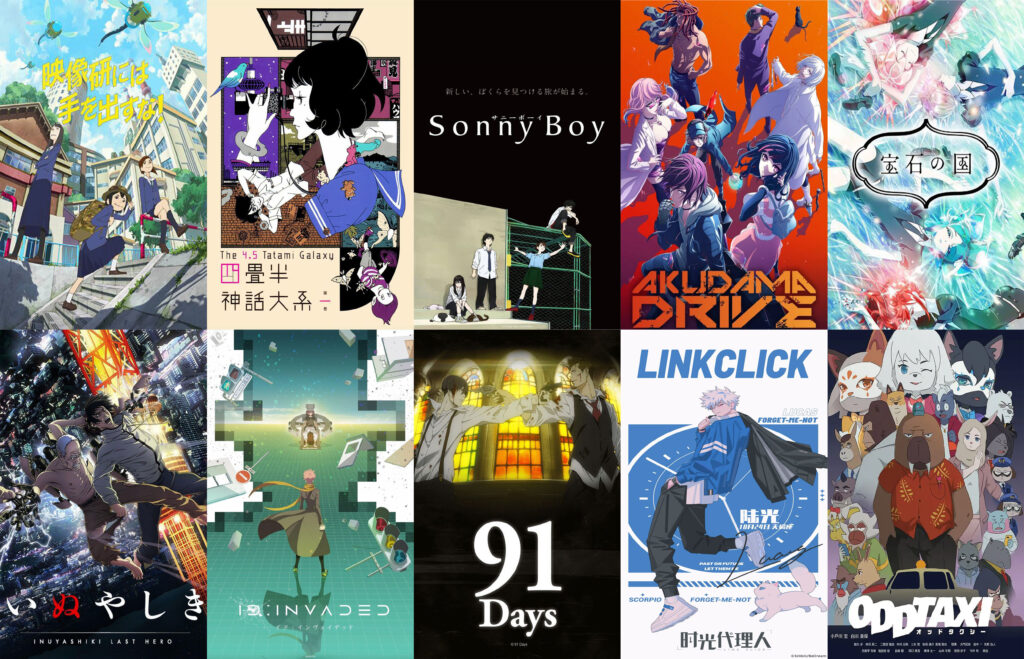
1. Odd Taxi
- Episodes: 13
- Studio: OLM, P.I.C.S.
The Story:
Set in a version of Tokyo populated by anthropomorphic animals, the story follows Hiroshi Odokawa, a cynical walrus who drives a taxi. What starts as a series of mundane conversations with his passengers quickly spirals into a dark mystery involving a missing high school girl, the yakuza, and a struggling idol group.
The Critique:
Odd Taxi is arguably one of the smartest scripts ever written in anime history. The dialogue isn’t just words; it’s a puzzle. It manages to connect seemingly unrelated threads—a social media obsession, a mysterious nurse, a hitman, and a student seeking fame—into one breathtaking climax. - Why Watch? If you enjoy Quentin Tarantino-style films where dialogue is king and the ending makes you re-evaluate every scene you’ve watched from the start.
2. Inuyashiki: Last Hero
- Episodes: 11
- Studio: MAPPA
The Story:
Ichiro Inuyashiki is an elderly man ignored by his family and diagnosed with terminal cancer. One night, a mysterious extraterrestrial accident reconstructs his body into a lethal killing machine. Simultaneously, a high schooler named Hiro Shishigami undergoes the same transformation. One chooses to be a savior to feel human; the other chooses to be a murderer to feel alive.
The Critique:
MAPPA delivers a chilling moral conflict here. The anime focuses on the psychology of power. How can a machine be more human than a person? - Visual Aspect: The use of CGI in designing the mechanical weapons emerging from human flesh was innovative and haunting, perfectly serving the show’s dark psychological tone.
3. Link Click
- Episodes: 11 (Season 1)
- Production: Studio Lan
The Story:
In a corner of a busy city, two young men, Cheng Xiaoshi and Lu Guang, run a small photo shop. They possess a unique power: entering photos and living the moment they were taken. They use this to fulfill client requests, but the golden rule is: “Never change the past.”
The Critique:
Despite being a “Donghua” (Chinese animation), it has taken the global anime community by storm. The excellence here lies in the emotional weight. Every photo they enter carries a human story—regret, lost love, or crime. The OST is a true hero, especially the ending theme that kicks in just before the episode ends, maximizing the suspense.
4. Akudama Drive
- Episodes: 12
- Studio: Pierrot
The Story:
In a dystopian future where Japan is divided between Kansai and Kanto, conflicts erupt between highly dangerous criminals known as “Akudama.” An ordinary girl finds herself caught in the middle of a suicide mission to rescue a death-row inmate and must pretend to be a “Swindler” to survive.
The Critique:
This anime is a color explosion. If you love Cyberpunk aesthetics, Akudama Drive will blow you away. The writing follows a video-game-like structure: escalating levels of danger and characters with exaggerated but incredibly fun abilities. - The Message: Beneath the flashy visuals, it asks a profound question about justice: Who is the real criminal—the one who breaks the law or the one who writes it?
5. ID: INVADED
- Episodes: 13
- Studio: NAZ
The Story:
The plot follows Sakaido, a genius detective who dives into “ID Wells”—virtual worlds created from the residual drive to kill within criminals. Inside these worlds, he must solve the mystery of the murder so the police in the real world can catch the killer.
The Critique:
This show masterfully blends hard Sci-Fi with traditional detective noir. The design of the ID Wells is breathtaking; each world reflects the killer’s psyche (a broken world, a burning world, a frozen world). It provides a broken protagonist, making the relationship between him and the cases he solves deeply personal.
6. 91 Days
- Episodes: 12
- Studio: Shuka
The Story:
During the Prohibition era in the United States, Avilio witnesses his family being murdered by a mafia mob. Years later, he receives a mysterious letter that prompts him to return to his city and infiltrate the same mob to destroy the mastermind from within.
The Critique:
This isn’t a traditional “action” anime; it’s a dark Noir drama. The focus is on atmosphere—the smell of cigarettes, the taste of betrayal, and the weight of regret. The relationship between the protagonist and his enemy (who becomes his close friend) is one of the most complex in short-form storytelling.
7. Houseki no Kuni
- Episodes: 12
- Studio: Orange
The Story:
In a distant future, the Earth is inhabited by immortal lifeforms made of gemstones. The protagonist, Phos, is the weakest among them and struggles to find a purpose in a society that constantly fights “Moon People” who want to kidnap the gems for jewelry.
The Critique:
This is the definitive answer to anyone who says 3D CGI anime is bad. Studio Orange delivered a visual masterpiece where the gems glisten and shatter in stunning detail. - The Philosophy: It deals with the theme of “change.” Every time Phos loses a part of their body and replaces it with another material, they lose part of their memories and personality. It’s a painful search for self.
8. Sonny Boy
- Episodes: 12
- Studio: Madhouse
The Story:
Suddenly, a high school finds itself drifting in a black void. The students discover they have supernatural powers, but they are also stuck in dimensions that follow strange, incomprehensible physical laws.
The Critique:
Sonny Boy is an “experimental” anime. Director Shingo Natsume doesn’t expect you to understand everything through logic. It relies on high symbolism, speaking about adolescence, the urge to escape, and the fear of the future. The absence of a traditional soundtrack in many scenes emphasizes the feeling of isolation.
9. Keep Your Hands Off Eizouken!
- Episodes: 12
- Studio: Science SARU
The Story:
Three high school girls—a genius artist, a strict financial manager, and a famous actress—unite to found a club to produce their own anime. The work follows their journey from “idea” to “execution” and the technical and financial difficulties they face.
The Critique:
If you want to know why we love anime, watch this. Director Masaaki Yuasa blends reality with the girls’ imagination; when they talk about an idea, the world around them transforms into rough animated sketches. It is an anthem for every creative person trying to build something from nothing.
10. The Tatami Galaxy
- Episodes: 11
- Studio: Madhouse
The Story:
An unnamed college student relives his university years over and over again. Every time, he chooses a different club (Tennis, Cinema, etc.) in search of the “rose-colored life” he dreams of, and every time, he ends up in regret.
The Critique:
Famous for its incredibly fast-paced dialogue, this show is a stylistic masterpiece. The art style is surreal and vastly different from mainstream anime. - The Life Lesson: It teaches us that the “rose-colored life” isn’t in the choices we make, but in how we live the present moment and accept imperfections. The ending is genius and ties every scattered thread together.
Conclusion: Discovering the Underrated
These ten series represent the very best of what the anime industry has to offer beyond the mainstream spotlight. They prove that you don’t need a massive franchise or infinite episodes to leave a lasting impact on an audience. By exploring these “Hidden Gems,” you are supporting creative risks and unique storytelling that keep the medium fresh and exciting.
Which of these underrated short series will you start tonight? Is there a hidden masterpiece we missed? Let us know in the comments below and help other fans find their next favorite show!